
City Foundry STL Illustrates the Financial Playbook Emerging in Rust Belt Redevelopment
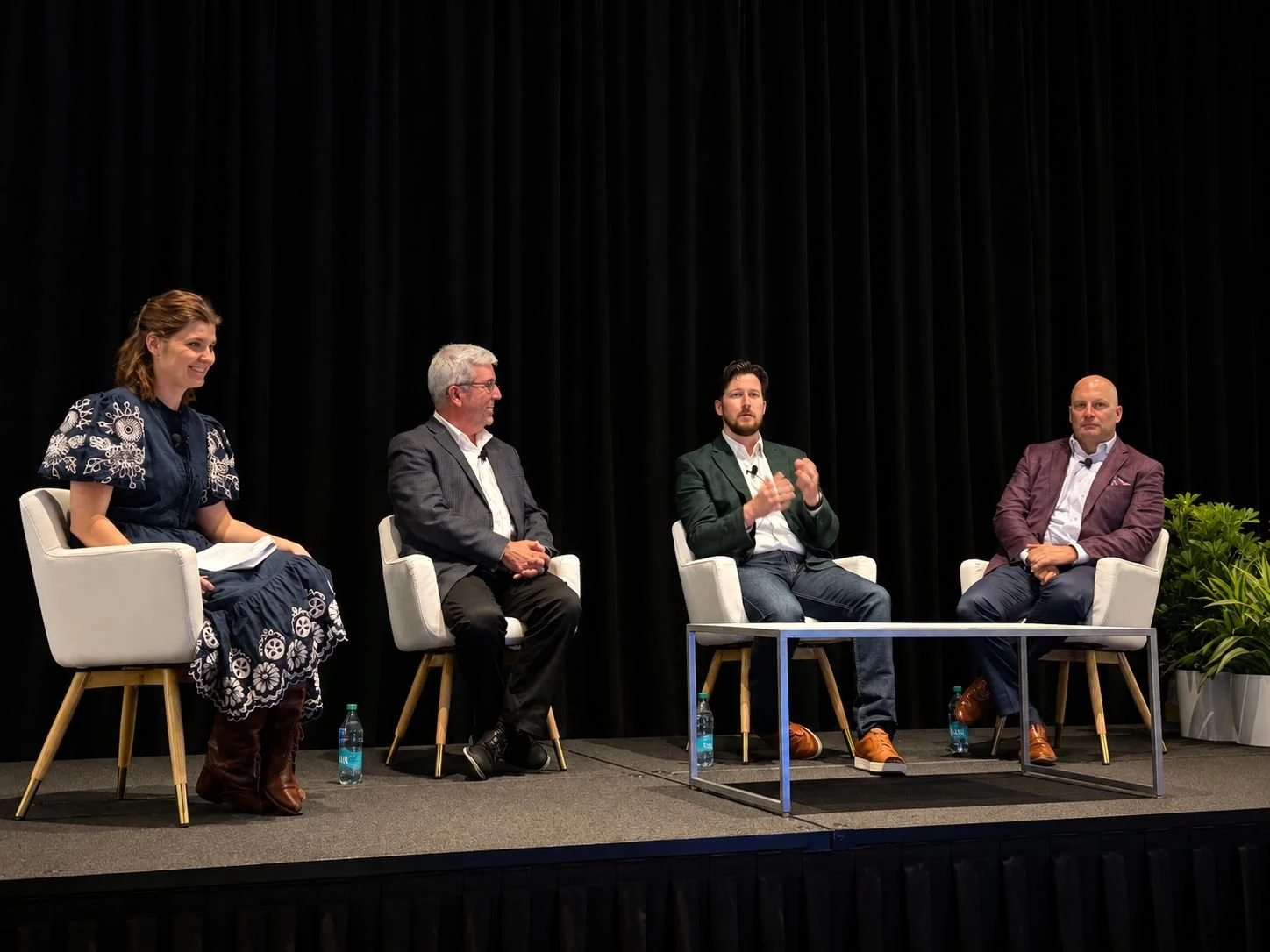
Susie Bonwich of PGAV Planners moderated a panel featuring Steve Smith and Will Smith of New + Found and Mark Brandom of CIBC on the financing, redevelopment, and evolution of City Foundry STL during 2026 ULI Spring Meeting. Photo courtesy of ULI.
This article was published in Urban Land Magazine on May 8, 2026.
At ULI’s Spring Meeting 2026, New + Found along with our partner at CIBC Bank detailed how layered financing, Opportunity Zone equity, and aggressive site activation helped transform a vacant St. Louis industrial property into a thriving mixed-use district.
City Foundry STL—the 15 acre (6 ha) adaptive reuse redevelopment that transformed a long-vacant St. Louis, Missouri industrial site into one of the city’s leading mixed-use destinations—would probably not have happened without Opportunity Zone financing, according to the developers behind the project. Speaking at ULI Spring Meeting 2026, panelists detailed how the redevelopment assembled an unusually complex capital stack that combined Opportunity Zone equity, historic tax credits, brownfield incentives, philanthropy, and conventional debt to reposition the former Century Electric Foundry after years of failed redevelopment efforts.
“This project would not have happened without [Opportunity Zones],” said Steve Smith, founder of New + Found and cofounder of Lawrence Group.
By the time City Foundry STL officially opened in 2021, the project had already survived environmental remediation, financing negotiations, lease restructuring, and the Covid-19 pandemic. The redevelopment ultimately transformed the contaminated industrial property in midtown St. Louis into a mixed-use district anchored by a food hall, offices, entertainment, retail, and residential uses. Panelists said the project’s greatest challenge was not design but instead was creating a financing structure sophisticated enough to make large-scale adaptive reuse feasible in a slower-growth legacy city.
Moderator Susie Bonwich of PGAV Planners was joined by Steve Smith and Will Smith of New + Found, as well as by Mark Brandom of CIBC, for a discussion that focused on how developers increasingly must combine multiple public and private financing tools to execute transformative redevelopment projects in markets such as St. Louis.
The site itself came with enormous complexity from the start. The former Century Electric Foundry had been vacant since 2007, and it stood on contaminated industrial land near downtown St. Louis. Earlier redevelopment plans called for demolishing the structures entirely and replacing them with conventional suburban-style retail.
Instead, the development team chose to preserve and reposition the industrial buildings after visiting such projects as Ponce City Market and Krog Street Market in Atlanta. “We knew we couldn’t let that happen,” Steve Smith said of the proposed demolition plans. “Why would you tear this down and build something like every place else?”
Preserving the structures required a far more complicated financial strategy, though. The acquisition alone involved environmental liability concerns and required New + Found to negotiate indemnification terms with the seller, Federal-Mogul. The development team ultimately purchased the property in late 2015 by using a mix of conventional bank financing, subordinate loans backed through New Markets Tax Credit structures, and developer equity.
Environmental remediation became the next hurdle. Missouri’s brownfield tax credit program reimbursed 100 percent of eligible remediation costs, eventually covering roughly $5.2 million in cleanup expenses. At the same time, the project team worked to place the foundry on the National Register of Historic Places, opening the door to both state and federal historic tax credits.
“The National Park Service loved the project,” Steve Smith said. He added that the service called Century Electric Foundry “the state of the art of manufacturing in 1920.”
Opportunity Zones Changed the Equation
Even after remediation and historic designation, the project still struggled to attract conventional institutional equity. “St. Louis is a hard place to be a national investment, compared to a lot of other tertiary markets,” Steve Smith said.
That challenge shifted with the arrival of Opportunity Zone legislation in late 2017. The development team formed its own Opportunity Zone fund and ultimately raised $50 million—a good deal more than the roughly $38 million originally targeted. The Opportunity Zone equity became one layer in an increasingly complex capital stack that also included senior construction debt, subsidy-backed loans, tax credit equity, philanthropic investment, and developer equity.
One particularly unusual component involved a $15 million subordinate loan tied to a philanthropic gift made through Saint Louis University. According to Steve Smith, the family behind Enterprise Rent-A-Car donated funds to the university specifically for investment into the project because of the site’s importance to Midtown St. Louis.
By the time financing closed in July 2019, the project included an $81 million senior real estate loan, a $30 million subsidy bridge loan, approximately $40 million in historic tax credit equity, $50 million in Opportunity Zone equity, multiple city-backed tax mechanisms, and additional developer equity.
CIBC ultimately syndicated portions of the financing across eight banks. “We’ve had people within our organization say this was probably the most complicated deal the bank has ever done,” Brandom said.
The project’s complexity came not only from the number of capital sources but also from the number of parties involved in approvals and decision-making. “Anytime you do anything, all these parties have to consent,” Steve Smith said. “It could be cumbersome.”
Covid Forced the Project to Reinvent Itself
The financing closed in July 2019. Eight months later, the pandemic upended the hospitality and entertainment industries. Several major tenants either failed or restructured during Covid, including Punch Bowl Social and concepts tied to McGurk’s Hospitality Group. Leasing momentum slowed dramatically, just as the project needed to stabilize.
At one stage, the development lost roughly half of its original preleasing. “We had to rebuild all these tenants,” Steve Smith said.
The project’s food hall strategy also had to evolve quickly. Originally built around traditional lease structures, the team pivoted toward percentage-rent agreements and shorter-term licensing models that reduced risk for local operators. “We found ourselves in the people-attraction business,” Will Smith said.
The shift ultimately reshaped the entire operating philosophy of the project. Instead of functioning simply as a collection of tenants, City Foundry STL increasingly focused on activation through events, concerts, pop-up programming, cultural gatherings, and local partnerships designed to drive repeat visits. Those efforts began before the project officially opened, including large drive-through fundraising events for St. Louis hospitality workers and temporary concert activations staged during the pandemic. “That really became a core part of our strategy around marketing,” Will Smith said.
The approach worked. Today, City Foundry STL attracts roughly 2.4 million visitors annually and is one of St. Louis’ leading tourism and entertainment destinations. “We went from zero. We went from a site that smelled . . . that now [draws] millions of people every year,” Will Smith said.
The redevelopment also catalyzed surrounding investment across Midtown St. Louis, including apartments, hotels, research facilities, retail, and entertainment uses. According to Steve Smith, surrounding land values rose substantially since the project began, and additional phases of development are already underway.
During the panel’s Q&A session, the team also noted that, after navigating years of pandemic-related disruptions and lease restructuring, the project refinanced earlier this year into a CMBS loan structure.